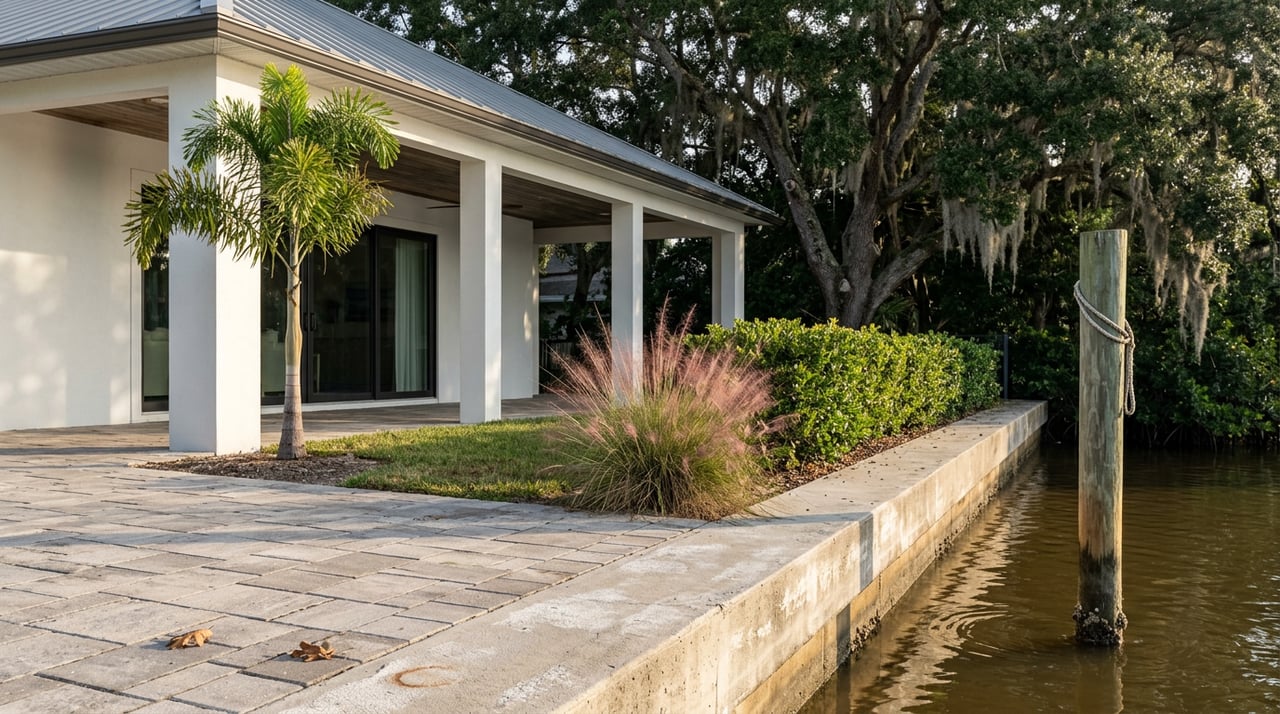
A little over a month ago, construction crews closed the public docks along downtown Stuart's waterfront and started tearing out a floating dock system that storms had been chewing up for years. A few hundred yards away, across the causeway, dredging equipment is deepening a basin for a marina three or four times that size. And a few hundred yards past that, on the site where a lighthouse-shaped restaurant stood until 1962, a developer is waiting on paperwork for a third project that needs no public vote to break ground.
Three separate entities are solving the same problem on the same half mile of river at the same time. That is not a coincidence. It is a scarcity math problem that has been building for years, and it is going to change which blocks near downtown Stuart carry a walkability premium long before any of the pricing sites catch up to it.
The math behind all that concrete
Martin County has roughly 18,000 registered boaters, and the Treasure Coast as a whole has about 46,000, according to a developer interview published by Straticon. Set against that demand, the same interview puts countywide dry storage at fewer than 4,000 slips. That gap is the entire reason three different parties are pouring money into the same stretch of waterfront in the same year. A city government does not usually rebuild its public docks and two private developers do not usually break ground on competing marinas within months of each other unless the underlying demand has been outrunning supply for a while.
That gap also explains why the projects look nothing alike. One is a modest public amenity. Two are private bets that boaters will pay to park somewhere better than they can right now.
Three projects, one six-block stretch of river
The City of Stuart Courtesy Dock, the smallest of the three, started construction on July 6, 2026. It is a $3 million rebuild funded by a $1.15 million grant from the Florida Inland Navigation District along with transportation impact fee funds, replacing an aging 5,533 square foot floating dock with a fixed dock system built to survive storm surge. Public Works Director Milton Leggett told the city commission the old system needed constant repair, since the floating dock's finger piers took damage from waves and storms every year, while the fixed sections never did. When finished, the facility grows from 18 slips to 44, serving the roughly 1,450 boaters who use it annually. The project is on track to wrap before the 2027 Fourth of July celebration, and the city is tracking progress on its own capital project page.
Atlantic Point Marina, under construction on the east side of the causeway on the former Evinrude site, is the biggest of the three. Reporting on the project has put its cost at $62.5 million, while the developer's own team has described it in interviews as an $80 million undertaking, a gap worth flagging rather than resolving, since construction budgets for projects this size shift as they progress. What is not in dispute is the scale: a destination marina with more than 400 slips, plus a 6,510 square foot restaurant space at 75 Northwest Flagler Avenue that is already being marketed around its dock-and-dine appeal. Because the site takes on water during king tides, the developer is raising the entire property three feet using fill dredged from the marina's own basin, a detail that matters for anyone weighing flood exposure on nearby parcels. Completion is expected in summer 2027.
Capri Harbor Stuart, the third project, is proposed for 7.3 acres at 50 and 54 Northwest Dixie Highway, on the west side of the causeway near the Old Roosevelt Bridge. This is where the Lighthouse Restaurant stood until the city tore it down in 1962 to widen the road for the original bridge, before the current high-rise span opened in 1996. The plan calls for 158 slips for vessels between 25 and 150 feet, a two-story restaurant seating up to 275, a 1,442 square foot ship's store, and a covered floating bar on the river, according to reporting from WQCS.
A tree where the lighthouse would have gone
Here is where the story stops being simple math and starts being a genuine argument about what downtown Stuart is supposed to look like.
The city's Community Redevelopment Agency and Stuart Main Street have spent the past few years pushing to get Downtown Stuart and the East Stuart Historic District listed on the National Register of Historic Places. The Florida National Register Review Board approved the nomination in May 2026 and forwarded it to the National Park Service for final action. Listing does not restrict what private owners can do with their property, but it does open the door to preservation incentives and puts a formal stamp on the idea that this downtown's look matters.
At almost the same moment, Capri Harbor Stuart cleared its own path without needing that conversation at all. Changes to city ordinances mean the project can proceed administratively, without a commission vote, as long as it meets code. Development Director Jodi Kugler told commissioners the design drew concern because it reads as more modern than the traditional buildings downtown is known for, but as she put it, the plans meet the arches and vista requirements the code actually asks for. Commissioner Eula Clark raised the same concern on the record, and reporting from CBS12 noted that no member of the public spoke up at the meeting where the renderings were shown, and neither did the developers.
Not everyone sees the clash as a problem. Steve Rogers, who owns Lisa Gay Fashion downtown, told CBS12 that the economic upside of hundreds of new boat slips outweighs his concerns about a building that will not look like it was built in 1900.
Across the causeway, Atlantic Point took a different approach to the same tension. Early plans for the marina included a lighthouse tower as a design feature, but the developer agreed to plant a tree on that spot instead, along with reserving a slip for a police boat and widening the public sidewalk to eight feet, according to Straticon's coverage of the commission's unanimous approval.
Neither approach is wrong. But they are pulling in different directions on the same six blocks, and that matters for anyone trying to read what downtown Stuart will feel like in two years.
What the median price doesn't show
If you pull Stuart housing data from four different sources right now, you get four different stories. One national portal puts the median sale price over the trailing three months at $307,000. Another puts the citywide median at $405,000, down more than 20 percent year over year. A third lists a median list price near $500,000 as of July 2026. A fourth, tracking average list prices across all property types, shows single-family homes averaging over $1.6 million in February 2026 while condo list prices fell from roughly $482,000 to $361,500 over the same twelve months.
Those numbers are not really in conflict. They are measuring different things: different boundaries, different property mixes, different windows of time. But the spread itself is the point. A single median headline cannot tell you what a marina supply shock does to the value of walkable, dock-adjacent property near downtown, because that shift has not shown up in twelve months of closed sales yet. It is still under construction.
What this means if you're looking at property near the water
Timing is the first thing worth sitting with. Atlantic Point Marina is targeting summer 2027 completion, and the city's own courtesy dock rebuild is due to wrap around the same window. Capri Harbor Stuart has cleared its administrative review but has not broken ground and has no public completion date yet, so it trails the other two by an uncertain margin. That gap between projects means road changes near the causeway, a temporarily closed public dock, and active construction on at least one major site will likely stretch well into 2027. That window can mean short-term noise for anyone living close to Dixie Highway or Flagler Avenue, and it can also mean an entry point before the amenity is finished and priced in.
Proximity is the second. Not every block near downtown gets the same lift from three marinas coming online at once. Property within an easy walk of Flagler Avenue and the causeway stands to see the most direct benefit from dock-and-dine traffic, since Atlantic Point's own leasing materials are built around exactly that appeal. Blocks further from the water, however historic, are not automatically carried along by the same wave.
The historic designation is the third piece worth watching, separate from the marinas themselves. If the National Park Service finalizes the Downtown Stuart and East Stuart listings, owners inside those boundaries may gain access to preservation incentives that owners a few blocks away do not have, even though the listing itself imposes no new restriction on what they can do with their property.
None of this shows up in a median price pulled from twelve months of closed sales. It shows up in slip counts, permit files, and city commission minutes, which is exactly why it is worth tracking now rather than waiting for the portals to catch up.
Frequently Asked Questions
When will the new marinas actually open? The City of Stuart's courtesy dock rebuild is targeting completion before the 2027 Fourth of July celebration. Atlantic Point Marina is expected to complete in summer 2027. Capri Harbor Stuart has not broken ground as of this writing and does not yet have a public completion date.
Will construction disrupt the downtown waterfront in the meantime? The public courtesy docks are closed for the duration of their rebuild. Traffic and site work around the causeway near Atlantic Point and the proposed Capri Harbor site should be expected to continue through at least mid-2027.
Does the pending historic district listing restrict what I can do with my property? No. A National Register listing does not place restrictions on private property owners. It can open access to preservation incentives and raises the profile of the district, but it does not require commission approval for renovations the way a local historic overlay might.
If you are weighing a property near downtown Stuart's waterfront and want a read on how these projects might affect a specific block or listing, The Stracuzzi Team has been tracking this market long enough to separate the noise from what actually moves value. Schedule a consultation and we'll walk through it together.
